What Is the Difference Between a Stand Mixer and a Regular Mixer?
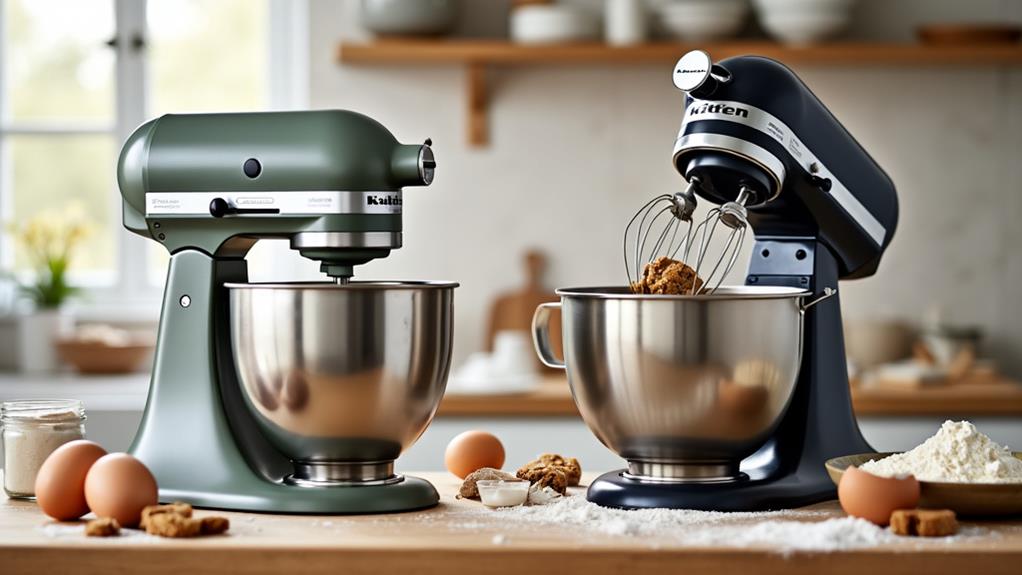
When choosing between a stand mixer and a hand mixer, it's important to consider their design and functionality. Stand mixers, equipped with powerful motors and larger bowls, are ideal for heavy-duty tasks like kneading dough. Conversely, hand mixers are lightweight and portable, making them perfect for smaller tasks such as whipping cream. Both types come with various attachments and are user-friendly, but the key differences lie in their size, power, and application. How do these factors influence your cooking experience and kitchen space? Let's explore further.
Design and Portability
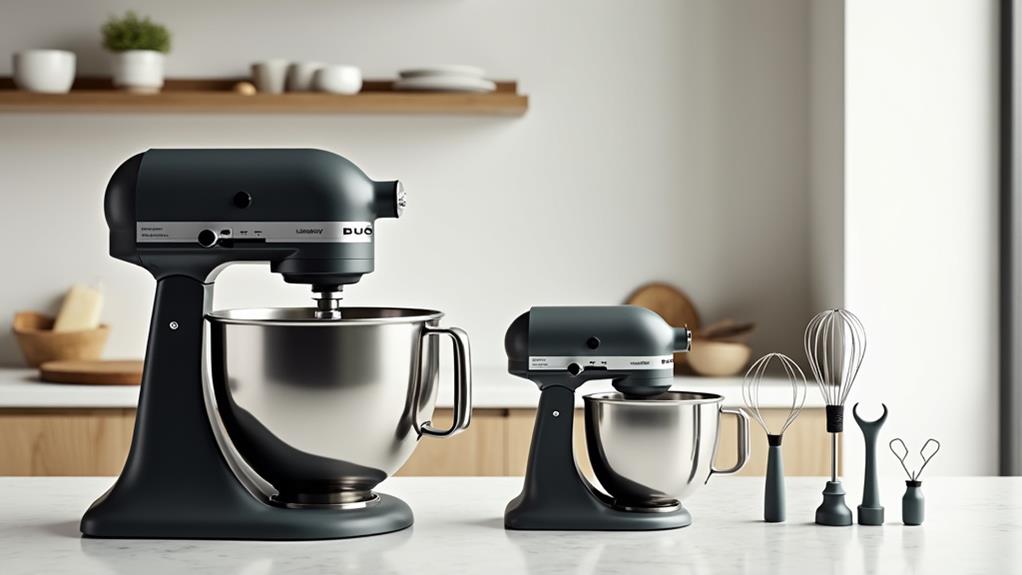
When evaluating the design and portability of mixers, it becomes evident that stand mixers are stationary appliances designed to reside on your countertop, often weighing between 20 to 50 pounds. These appliances feature either a bowl-lift or tilt-head mechanism for easy access to the mixing bowl. With bowl capacities of up to 7 quarts, stand mixers are ideal for preparing larger batches of dough or batter. They come with multiple attachments and accessories, enhancing their versatility. However, they require dedicated counter space and represent a significant investment in terms of both space and budget.
Conversely, hand mixers boast a more compact and lightweight design, making them easy to maneuver and store in small cabinets or drawers. Their ability to be used directly in any bowl or pot offers flexibility but limits the batch size you can handle at once. While hand mixers typically come with standard beaters, they may offer fewer specialized attachments compared to stand mixers. Their design and portability make them well-suited for quick tasks and small kitchens where space and budget are limited. Ultimately, the choice between a stand mixer and a hand mixer depends on your specific mixing needs and available kitchen space.
Power and Capacity
Stand mixers generally feature motors of 500 watts or more, making them ideal for heavy-duty tasks like kneading dough. In contrast, regular hand mixers usually come with 200 to 300-watt motors, suitable for lighter tasks. Additionally, stand mixers often have bowls with capacities of up to 7 quarts, while hand mixers are limited to smaller bowls and batches.
Motor Wattage Comparison
In the realm of kitchen appliances, motor wattage is a crucial factor distinguishing stand mixers from hand mixers. Stand mixers typically feature motors ranging from 300 to 500 watts, enabling them to handle heavier doughs and larger batches effectively. In contrast, hand mixers usually have motors between 200 and 250 watts, making them ideal for lighter tasks like whipping cream or mixing batters.
The higher wattage in stand mixers allows them to maintain consistent speed and performance, even with dense mixtures, reducing motor strain and enhancing efficiency. Stand mixers often come with bowl capacities of up to 7 quarts, accommodating larger quantities, whereas hand mixers are limited by the size of the bowl they are used with.
Additionally, stand mixers offer hands-free operation, allowing you to set the mixer and let it work autonomously, making it more efficient for lengthy mixing tasks compared to the manual operation required by hand mixers. For robust and versatile mixing, a stand mixer is the superior choice.
Bowl Size Variations
Stand mixers and hand mixers differ significantly in motor wattage, bowl size, and capacity, impacting their utility in the kitchen. Stand mixers typically offer bowl capacities ranging from 4.5 to 7 quarts, making them ideal for larger batches of dough and batter. In contrast, hand mixers generally feature smaller bowls, around 3 to 5 quarts, limiting their effectiveness for extensive mixing tasks.
Here's a quick comparison:
| Feature | Stand Mixers | Hand Mixers |
|---|---|---|
| Bowl Capacities | 4.5 to 7 quarts | 3 to 5 quarts |
| Mixing Tasks | Heavy doughs | Light tasks |
| Flexibility | Multiple bowl sizes | Fixed bowl |
| Mixing Efficiency | Superior | Prone to uneven mixing |
| Batch Size | Larger batches | Smaller batches |
The larger bowls of stand mixers facilitate more significant ingredient incorporation and aeration, reducing the likelihood of uneven mixing often seen with the smaller bowls of hand mixers. Additionally, stand mixers offer flexibility with multiple bowl sizes and shapes, supporting various mixing tasks. This adaptability and capacity make stand mixers highly effective for larger recipes, enhancing their utility in the kitchen.
Versatility and Attachments
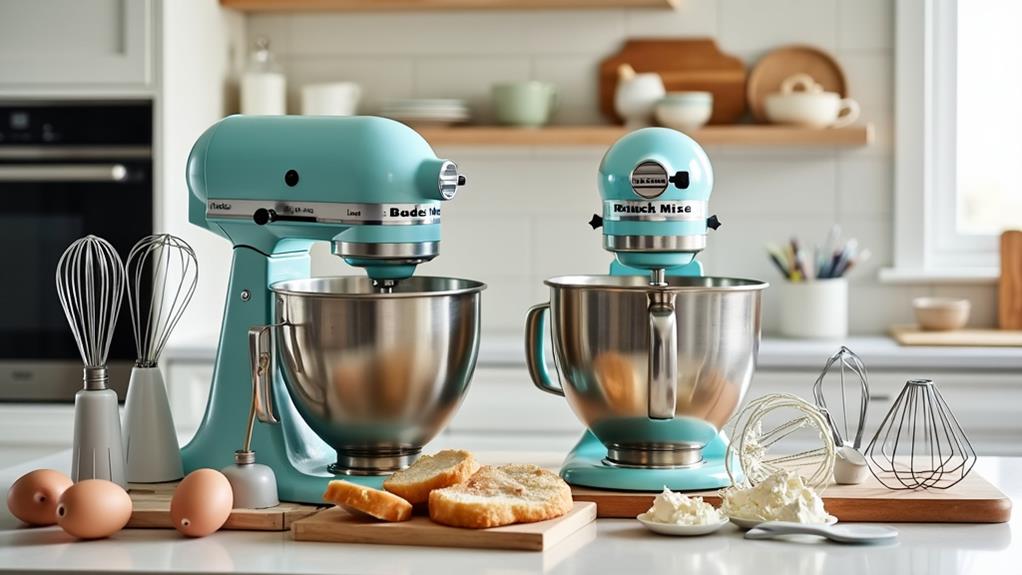
Stand mixers offer remarkable versatility due to a broad range of attachments such as dough hooks, whisks, and paddle beaters. These attachments transform the stand mixer into a multi-functional kitchen tool, allowing for efficient kneading of dough, whipping of cream, and mixing of batters. Unlike hand mixers, which typically come with basic beaters and occasional whisks, stand mixers can include additional attachments for tasks like pasta making and food grinding. Optional extras can even spiralize vegetables or make ice cream, greatly expanding your culinary capabilities.
The stand mixer's versatility is further enhanced by its higher wattage motor, which effortlessly handles tough tasks like heavy bread dough. The powerful mixing action mimics that of professional chefs, ensuring consistent and thorough mixing. This hands-free operation allows you to gradually add ingredients, simplifying complex recipes. While hand mixers are useful for basic tasks, they do not match the comprehensive capabilities of stand mixers. Whether you are a novice cook or an experienced baker, investing in a stand mixer can significantly broaden your cooking and baking horizons.
Task Suitability
When considering task suitability, stand mixers excel in larger, more demanding tasks. They're ideal for baking bread, handling heavy doughs, and managing longer mixing times. If you frequently bake large batches of cookies or cakes, a stand mixer will save you time and effort. Its power and stability guarantee consistent results, especially for complex recipes.
Conversely, hand mixers are perfect for small jobs and quick tasks. Whipping cream, beating eggs, or mixing batter for a single batch of cookies is where a hand mixer shines. They're lightweight and easy to store, making them a great choice for those with limited kitchen space or for occasional bakers.
The versatility of a stand mixer extends further with different attachments, transforming it into a multi-functional kitchen appliance capable of tasks like pasta making and meat grinding. Hand mixers, while useful, cannot match this level of functionality.
User Effort

Using a stand mixer offers hands-free operation, allowing you to multitask and reduce physical strain. Unlike hand mixers that require constant holding and maneuvering, stand mixers operate automatically, delivering consistent results without causing fatigue. Additionally, you can add ingredients without pausing the mixing process, enhancing efficiency and workflow.
Manual Vs. Automatic Mixing
With stand mixers, you can automate the entire mixing process, significantly reducing your physical effort. Simply set the speed, add ingredients, and let the machine handle the mixing. This automation frees you to multitask in the kitchen. Stand mixers are particularly advantageous for handling heavy doughs or large batches, as they ensure thorough mixing with minimal user intervention.
On the other hand, a hand mixer requires manual operation. You must hold the device and actively control it throughout the mixing process, which can be physically demanding, especially when dealing with dense ingredients or mixing for extended periods. Hand mixers typically offer 5 to 9 speed settings, necessitating constant adjustment and monitoring to achieve the desired consistency.
The hands-free operation of a stand mixer also features planetary mixing action, ensuring even mixing with little user effort. In contrast, hand mixers often struggle with dense mixtures, requiring more effort to achieve uniform consistency. Therefore, stand mixers provide a more efficient and less labor-intensive solution for various mixing tasks.
Physical Strain Reduction
One of the standout benefits of using a stand mixer is the reduction in physical strain. Unlike hand mixers, which require continuous manual effort, stand mixers offer hands-free operation, allowing you to multitask while your ingredients mix. This feature prevents arm fatigue and wrist strain, particularly with heavy mixtures like dough.
Stand mixers are also excellent for handling large batches, minimizing the repetitive stirring motions that can strain your wrists and shoulders. Their ergonomic design promotes a more comfortable mixing posture, enabling you to stand upright instead of leaning over a bowl. This setup is much kinder to your back and shoulders, making long baking sessions more enjoyable.
Additionally, the stationary design of stand mixers ensures stability, so you don't have to exert extra effort to control the machine. This stability is particularly beneficial when working with heavy mixtures that can be challenging to manage with a hand mixer. Overall, stand mixers significantly reduce the physical strain and effort involved in mixing, enhancing the comfort of your cooking and baking experiences.
Efficiency and Consistency
Stand mixers excel in providing unmatched efficiency and consistency in the kitchen, significantly reducing physical strain. Their hands-free operation allows for multitasking, drastically cutting down prep time. The planetary mixing action ensures thorough incorporation and aeration of ingredients, enhancing the consistency of batters and doughs.
Stand mixers handle heavy mixtures like bread dough effortlessly, unlike hand mixers that require more user effort. You can add ingredients without pausing the machine, streamlining the baking process and boosting efficiency.
| Feature | Stand Mixers | Hand Mixers |
|---|---|---|
| Operation | Hands-free | Manual |
| Mixing Action | Planetary | Basic |
| Handling Dense Dough | Effortless | Struggles |
| Ingredient Addition | During Mixing | Must Stop |
| Speed Settings | Up to 10 | 5 to 9 |
Stand mixers offer higher power and speed settings, up to 10 speeds, facilitating effective mixing for a variety of tasks. This leads to improved texture and rise in baked goods compared to the limited speed options of hand mixers. Overall, stand mixers deliver unparalleled efficiency and consistency to your baking endeavors.
Cleaning and Maintenance
Proper cleaning and maintenance of your mixer, whether it's a stand mixer or a hand mixer, are essential for ensuring its longevity and optimal performance. For both types, regularly inspect the beaters and attachments to ensure they are free of food residue. This not only keeps your appliance in good working order but also promotes a cleaner kitchen environment.
Stand mixers usually come with removable, dishwasher-safe attachments, simplifying the cleanup process. The bowl can also be removed and washed separately. In contrast, hand mixers often require manual washing of the beaters and whisks, which can be more time-consuming.
Due to their more intricate design, stand mixers may require more thorough maintenance. Periodic deep cleaning is recommended to ensure all parts are functioning correctly. Regularly wiping down the exterior of both types of mixers helps maintain their appearance. However, hand mixers generally need less frequent deep cleaning due to having fewer components and less exposure to ingredients.
Space and Storage
Maintaining the cleanliness of your mixer is crucial, but it's equally important to consider its space and storage requirements. Stand mixers are bulky, typically weighing between 20 to 50 pounds, and require dedicated counter space. This can be a significant drawback for small kitchens. With bowl capacities often up to 7 quarts, they further limit storage options. Stand mixers are generally kept stationary on countertops, occupying valuable space that could be used for other kitchen appliances.
In contrast, hand mixers are compact, lightweight, and can easily be stored in drawers or cabinets, making them ideal for small kitchens where counter space is limited. Many hand mixers come with built-in storage for attachments, simplifying organization. You can use a hand mixer in any bowl or pot and quickly tuck it away when finished, offering a versatile and space-efficient solution.
Limited kitchen space often makes hand mixers a more practical choice. They perform similar tasks to stand mixers without the need for extra storage or counter area. If space is a concern, a hand mixer is likely the better option.
Price and Value
When evaluating the price and value of mixers, the cost difference between stand mixers and hand mixers is immediately apparent. Stand mixers generally range from $300 to $700, making them a significant investment for serious bakers. In contrast, hand mixers cost between $30 and $100, appealing to casual users looking for a cost-effective option.
The higher initial price of a stand mixer is justified by its durability and extensive functionality. These mixers often serve as a long-term investment, capable of lasting for generations. Brands like KitchenAid are renowned for their reliability, making them a worthwhile investment for avid bakers. On the other hand, hand mixers are budget-friendly but may lack the long-term value and versatility needed for more complex baking tasks.
To summarize:
- Stand mixers: Higher initial cost but long-lasting and versatile.
- Hand mixers: Budget-friendly but less durable and functional.
- Refurbished stand mixers: Cost-effective alternative without compromising quality.
- Value for avid bakers: Stand mixers offer better long-term value and functionality.
Ultimately, if you're a passionate baker, investing in a stand mixer may provide greater value over time. However, if your baking needs are minimal, a hand mixer remains a cost-effective choice.